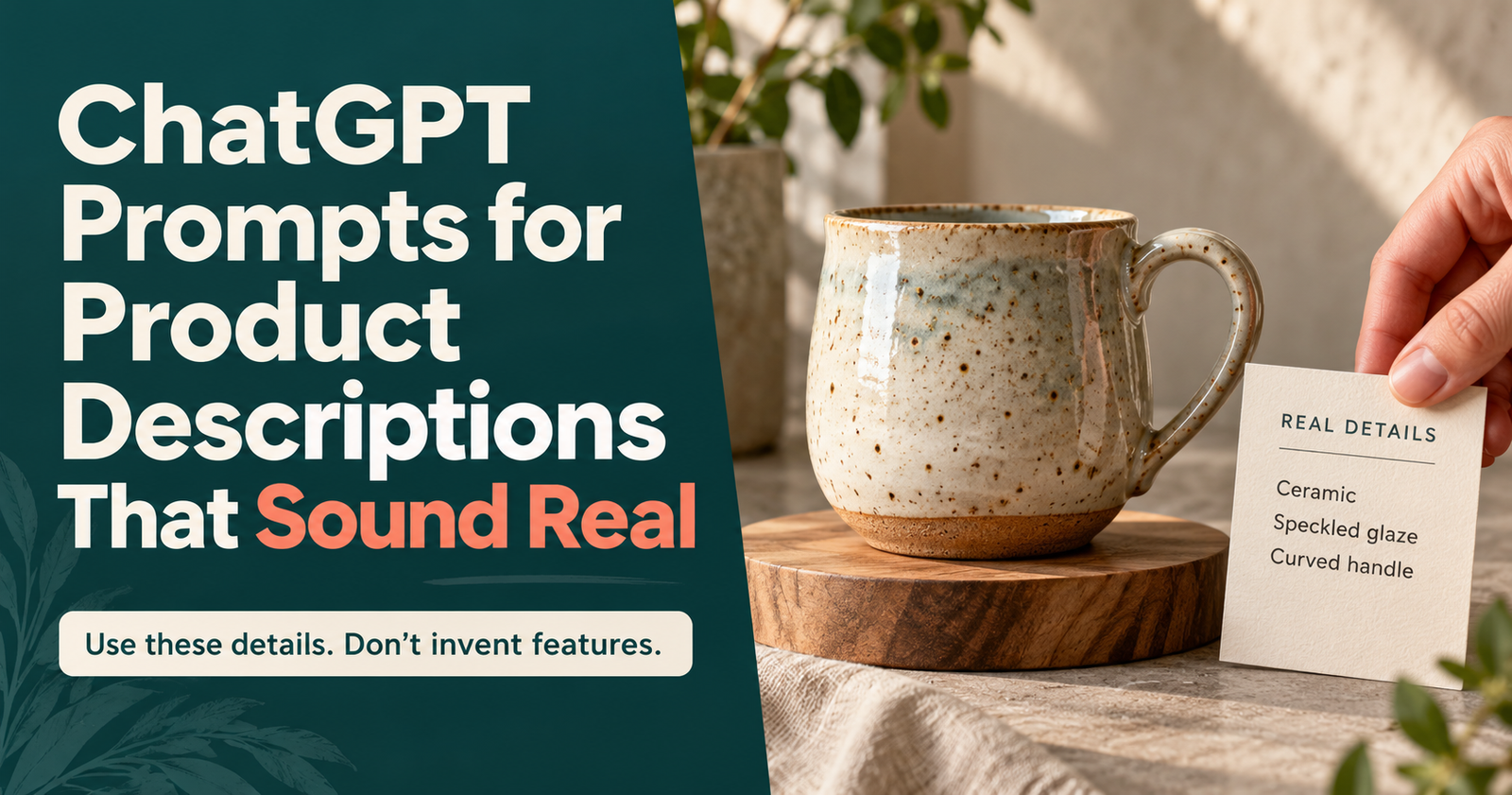
ChatGPT Prompts for Product Descriptions That Sound Real
October 11, 2026
Affiliate Disclosure: As an Amazon Associate I earn from qualifying purchases.
Learn more.
A product description has one simple job: help the right person understand what they are buying and feel good about buying it. That sounds easy until you have twenty listings to write, each product has slightly different details, and every draft starts sounding like “high quality,” “perfect for,” and “must-have.”
That is where ChatGPT can help, as long as you do not ask it to make things up for you.
I use ChatGPT prompts for product descriptions to organize the details I already know, find a clearer way to explain benefits, and turn rough notes into a useful starting point. I do not use it to invent product features, customer results, materials, shipping promises, or reasons somebody should trust me. That product-writing workflow fits into a broader approach to using ChatGPT as a helper, not an author, in use ChatGPT as a starting point.
The best product descriptions still come from knowing the product. AI just helps you say what you know in a way that is easier for a shopper to read.
Why generic AI product descriptions fall flat
Most shoppers can spot a vague product description without even thinking about it.
They have seen phrases like “crafted with care,” “elevate your lifestyle,” and “the perfect gift” a thousand times. Those phrases are not always wrong, but they do not answer the questions that make somebody buy.
A shopper wants to know what the item actually is, who it is for, what makes it different, how big it is, what it does, what is included, and what they should expect after ordering. Etsy sellers can also consider these broader Etsy shop success tips when building a product listing.
ChatGPT cannot know those things unless you give them to it.
If you type, “Write a product description for a handmade candle,” it will give you a candle description that could belong to almost any seller. If you tell it the wax type, scent notes, jar size, burn-time estimate, packaging, and the exact kind of person you made it for, the result has a real foundation.
Start with a product-details sheet before you open ChatGPT
Before I write a description, I gather the facts in one place. It does not need to be fancy. A note on my phone or a rough document works fine.
For each product, I want to know:
The exact product name.
What it is made of.
Its size, color, weight, capacity, or other measurements.
What comes with it.
How someone uses it.
Who it helps most.
What problem it solves or makes easier.
What makes it different from a similar item.
Any honest limitations or care instructions.
Shipping, customization, or compatibility details that matter.
That information is the heart of the description. ChatGPT should shape it, not replace it.
When your own details are thin, the final listing will be thin too. The answer is not asking AI for more exciting words. The answer is looking at the product again and noticing what a buyer would need to know.
This is the prompt I would start with for almost any physical or digital product:
Write a product description for [product name]. My customer is [describe the likely buyer]. They may be looking for this because [problem, goal, occasion, or need].
Use only the facts below. Do not invent materials, features, measurements, reviews, product results, shipping details, guarantees, or claims.
Write in a clear, natural American voice. Start by explaining what the product is and why it may be useful. Then explain the important details in short, easy-to-scan sections. Avoid clichés, fake urgency, and words like “perfect,” “must-have,” “premium,” or “game-changing” unless the facts clearly support them.
Product facts: [paste your notes]
The phrase “use only the facts below” is important.
AI tools are built to give an answer, even when you have not given them enough information. You want the tool to point out missing details, not quietly fill those gaps with something that is not true.
Prompt for a description that focuses on benefits without making big promises
A feature is what something has. A benefit is why the customer may care.
For example, “12-ounce stainless-steel tumbler” is a feature. “A smaller tumbler that fits easily in a cup holder and is easier to carry on errands” is a benefit.
Both belong in a good description.
Using the product details below, write a description that explains both the features and the practical benefits. Do not make health, financial, performance, or lifestyle promises. Use plain language that helps a shopper picture how they may use the item in normal life.
Product details: [paste details]
I like this prompt for products where the benefit is simple but important. A storage container may help somebody get a messy cabinet under control. A printable planner may help someone see their week on one page. A WordPress plugin may save a website owner from checking the same thing manually over and over.
The key is to describe the likely use honestly. Do not promise that a planner will transform someone’s life or that a kitchen tool will make them a better cook.
Prompt for a short description when your store layout has limited space
Not every product page needs a long story. Some stores need a short opening paragraph followed by clear facts.
Write a short product description of 60 to 90 words for [product name]. It needs to quickly explain what it is, who it is for, and the most useful reason someone may want it. Use the exact facts provided. Keep the tone warm and direct. Do not use hype, filler, or claims that cannot be proven.
Product details: [paste details]
Short copy still needs substance. I would rather see three useful sentences than a paragraph that repeats “beautiful,” “quality,” and “unique” in different ways.
Prompt for a longer description that answers buyer questions
Longer descriptions work well when a buyer may have questions before they can decide. This is common with digital products, tools, skincare, specialty items, personalized gifts, clothing, equipment, or anything that needs setup.
Write a detailed product description for [product name]. Use the facts below and organize the description under helpful section headings. Include what it is, who it is for, what is included, how it works or is used, important dimensions or compatibility details, and anything the buyer should know before ordering.
Keep the language simple and useful. Do not bury important limitations or requirements. Do not invent information. If a key buyer question cannot be answered from my details, list it for me at the end instead of guessing.
Product details: [paste details]
The strongest descriptions remove uncertainty. They do not leave a customer wondering whether something will fit, work with their setup, arrive in a certain format, or require an item they do not own.
Prompt for digital products that need clear expectations
Digital products especially need plain explanations because the customer cannot hold the item in their hand before they buy it.
If it is a printable, a template, a download, a spreadsheet, a guide, an app, or a plugin, say that early. Explain what the customer receives and what they will need to use it.
Write a clear product description for a digital product called “[product name].” Explain that it is a digital item, not a physical item. Based only on the facts below, explain what the buyer receives, how they access it, what they can use it for, and what they need before getting started.
Use plain language for a beginner. Do not promise that the product works with platforms, devices, or software unless I specifically list them. Do not add instructions that are not in my notes.
Product details: [paste details]
This one can prevent a lot of customer confusion. A shopper should not have to reach checkout before realizing they are buying a download instead of a shipped item.
Prompt for describing a product made in different sizes, colors, or versions
Variants are where descriptions can get messy fast. You do not want to write a totally separate page for a product that is mostly the same, but you also do not want customers guessing which option works for them.
I sell [product name] in these versions: [list versions]. Write a product-description section that helps a customer choose the right option. Clearly explain the difference between each version using only the facts I provide. Keep it easy to scan. Do not say one option is “best” unless there is a specific reason based on its use, size, material, or included features.
Version details: [paste details]
I would still double-check this carefully. Variations often have the details that lead to returns if they are misunderstood.
Prompt for Etsy product descriptions without copying your title
Etsy sellers sometimes repeat the title word for word in the description because they are trying to fit in every search phrase. That does not help the shopper much.
Your title helps people find the listing. Your description should make the person who found it feel more confident about it.
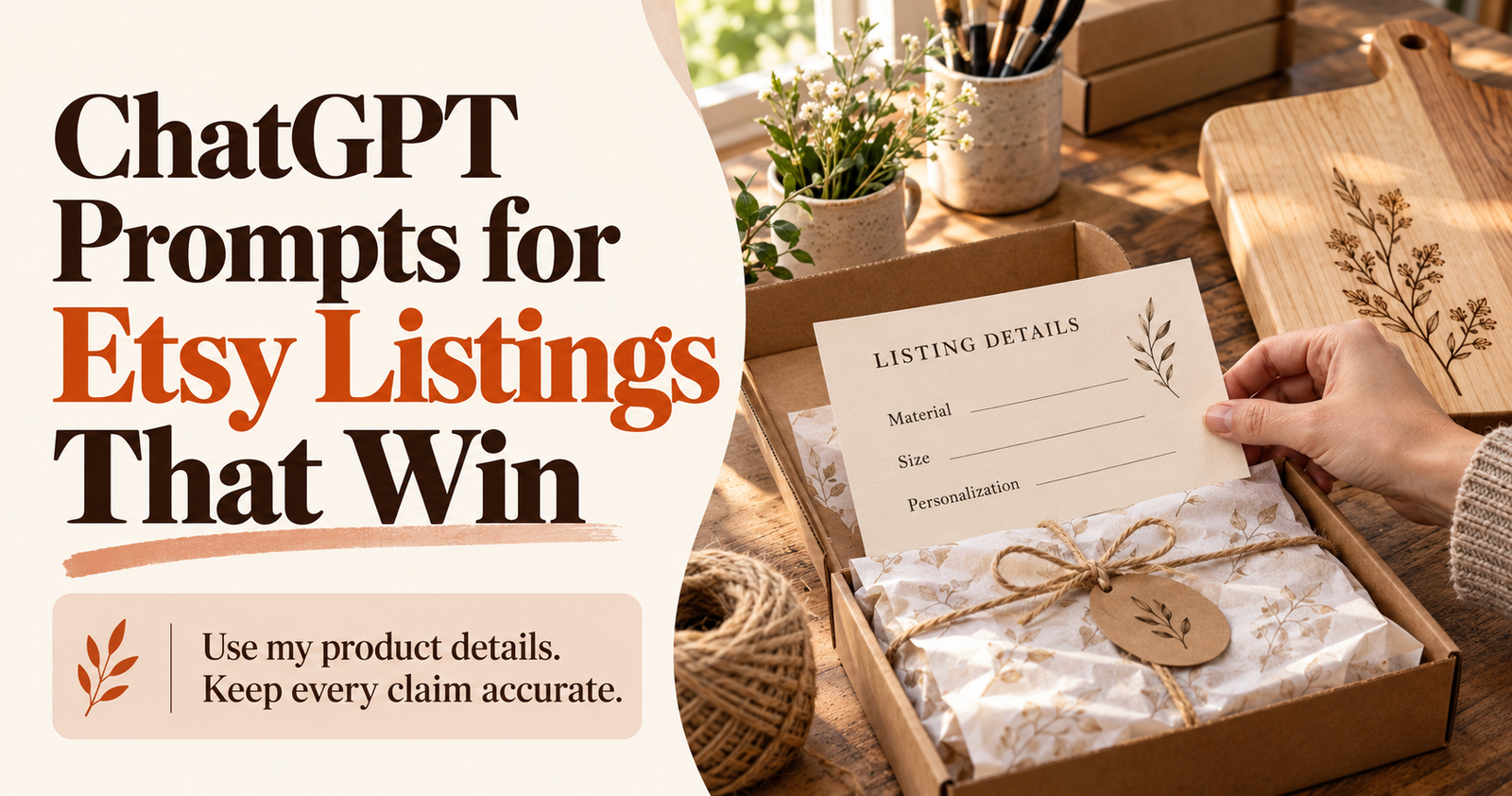
Write an Etsy product description for [product]. Do not repeat the title word for word. Start with a natural explanation of what the item is and who may enjoy it. Then include the real materials, size, personalization details, processing information, and care instructions from my notes. Keep the wording friendly and clear for a shopper using a phone. Do not make up production times, gift occasions, or customer feedback. For Etsy-specific listing guidance, use these ChatGPT prompts for Etsy listings to work through titles, descriptions, tags, and buyer questions.
Prompt for finding the buyer questions your description still misses
This is one of the most useful things I ask ChatGPT to do after a first draft is finished.
It is easy to understand your own product so well that you forget what a new customer will not know.
Read this product description as if you are considering buying the item for the first time. List the questions that are still unanswered. Focus on practical buying questions such as size, materials, fit, compatibility, included items, setup, care, customization, delivery format, and expected use. Do not rewrite the description yet.
Description: [paste your draft]
Then I decide which questions actually matter. You do not have to answer every possible question in the world. You do need to answer the questions that could stop the right buyer from feeling comfortable ordering.
Prompt for turning customer questions into a better product description
Customer messages are one of the best sources of real copy.
If buyers keep asking whether a file works on a phone, whether a shirt runs small, or whether an item can be personalized, that question belongs somewhere on the product page.
These are real questions customers have asked about my product: [paste questions]. Review them and identify which answers should be added to the product description. Write only the new sections or sentences needed. Use the exact answers I provide. Do not invent policies or details that are not included.
My answers: [paste answers]
This keeps your descriptions grounded in actual buyer hesitation instead of generic marketing ideas.
Prompt for writing a product description that sounds more like you
“Make it sound natural” is too vague for most AI tools. Give ChatGPT a sample instead.
Use a paragraph from your own site that sounds like you when you are at your best. It could be an older listing, an email, or a short article section. Do not paste somebody else’s writing and ask it to copy their style.
Here is a short sample of my writing: [paste sample]. Here is a product description draft: [paste draft]. Revise the draft so it has a similar level of warmth, directness, and plain language as my sample. Do not copy wording from the sample. Keep all product facts exactly the same. Do not add stories, claims, opinions, or details that are not already in the draft.
I still read the result out loud. If a sentence feels like something I would never say to a customer, I change it.
Prompt for writing product bullets without sounding like a catalog
Even though short lists can help shoppers scan a page, the items need to be specific enough to matter.
Create a numbered list of 4 to 6 key product details for [product name]. Each item should be brief but useful to a potential buyer. Use only the facts below. Focus on details that affect how the item is used, chosen, cared for, or understood. Avoid vague phrases such as “top quality,” “great value,” or “perfect gift.”
Product details: [paste details]
Afterward, put the most decision-making details first. For clothing, that may be sizing and fabric. For a digital tool, that may be compatibility and what it does. For a handmade item, that may be materials and variation.
Prompt for checking your description before it goes live
Before you publish, use ChatGPT as an editor instead of a writer.
Review this product description for clarity and trust. Identify:
Any vague wording that does not tell the shopper something useful
Any claims that I need to verify
Missing buying details that may cause confusion
Repeated information
Sentences that sound overly salesy or generic
Do not rewrite the full description. Give me a short, practical revision plan first.
Product description: [paste description]
That prompt can save you from posting something that sounds good at a glance but leaves buyers with unanswered questions.
What ChatGPT should never invent in a product listing
Product pages are not the place to take chances with made-up details.
Do not let ChatGPT invent:
Customer reviews or testimonials.
Product measurements.
Materials or ingredients.
Shipping and delivery promises.
Return policies.
Safety claims.
Compatibility details.
Certifications.
Product results.
Limited-stock claims or fake urgency.
If the tool gives you any of those things without you providing them, delete them or verify them before publishing.
Trust is worth far more than a description that sounds a little more exciting.
A simple process for writing product descriptions faster without making them worse
I would use ChatGPT in this order:
Gather the true product details.
Choose the one main reason the right buyer may care.
Use a prompt to make a rough first draft.
Check it against the actual product.
Add the questions real customers ask.
Remove generic phrases.
Read it on a phone screen before publishing.
If you sell many related items, save your best prompts in one document. Keep a version for physical products, digital items, personalized products, and product updates. That makes it easier to stay consistent without making every listing sound copied.
The goal is not to make ChatGPT write descriptions faster than you can think. The goal is to make your real product details easier for the right customer to understand.
Dax Weaver is an independent publisher who writes practical, plain-English guides for Make It Found to help website owners, creators, and small businesses get found online.