

A new blog does not need thirty random ideas. It needs thirty pages that make it easier for a real person to solve a connected set of problems.
That difference becomes painfully obvious later.
A website with thirty disconnected articles often feels busy but weak. It may have three articles answering nearly the same question, a few posts with no useful next step, and no clear reason for someone to keep reading after they land on one page.
A website with thirty planned posts feels different. Each article has a job. Some introduce the big subject. Some answer the questions people ask before they are ready for the big subject. Others solve the smaller problems that come up along the way.
That is how I would plan a new blog from the start.
Start with one subject you can actually cover well
Do not begin by asking, “What are thirty keywords I can write about?”
Start with a simpler question: “What problem do I want this site to become useful for?”

For Make It Found, the broad problem is helping small website owners become easier to find online. That can lead to subjects like indexing, keyword research, search intent, content planning, internal links, and WordPress organization. A concise introduction to these connected fundamentals appears in this getting found online basics.
Those are not random SEO terms. They are connected steps in a person’s real journey.
Your site may help new gardeners grow food, truck owners diagnose problems, small businesses get local customers, or parents understand a specific concern. The subject can be broad, but it still needs a center of gravity.
If you cannot explain the site’s main promise in one or two plain sentences, planning thirty good posts will be harder than it needs to be.
Separate the big topic from the questions underneath it
Every strong content plan has a broad topic and a group of smaller questions underneath it.
Think of the broad topic as the trunk of a tree. The smaller questions are the branches. The goal is not to create thirty branches that all grow in the same direction. The goal is to cover the subject from the angles a reader actually needs.
For example, “SEO for a new website” is broad. Underneath it, someone may ask:
- Why is my new site not showing up on Google?
- How long does SEO take?
- Can I rank without backlinks?
- How do I find keywords without paying for tools?
- How do I know if a keyword is too competitive?
- How often should I publish?
- Should I update old posts or write new ones?
- How do internal links help a small website?
Each question has its own purpose. None of them needs to fight for the same search intent.
That is the kind of separation you want before you write a word.



Do not plan thirty posts from one keyword list
Keyword tools can be helpful, but they can also hand you a list full of tiny wording variations that all deserve one page, not five.
“SEO for new websites,” “new website SEO,” “SEO tips for a new website,” and “how to do SEO on a new website” may look like four content ideas in a spreadsheet. In reality, they may all be asking for the same beginner guide.
Writing separate articles for each phrase creates overlap. It also makes it harder for Google and readers to understand which page is your main answer.
Instead, group similar phrases by the problem behind them.
If the same person would be satisfied by the same page, the phrases usually belong together.
Build your first 30 around five useful groups
I like to plan the first thirty posts in groups rather than one long list.
A simple structure is five groups of six articles. Each group covers one important part of the bigger subject, and each article inside that group has a distinct purpose.
For a new website SEO blog, the groups could look like this:
- Getting found and indexed.
- Choosing topics and keywords.
- Creating useful content.
- Organizing pages and internal links.
- Measuring and improving what is already published.
This gives you enough direction to move forward without making your plan feel like a prison. You can change the order as opportunities come up, but you are no longer guessing what to write every time you open WordPress.

Choose one main guide for each group
Each group needs a page that acts like the center of the conversation.
A main guide is not necessarily your longest post. It is the page that explains the broader problem and naturally points readers toward the more specific articles.
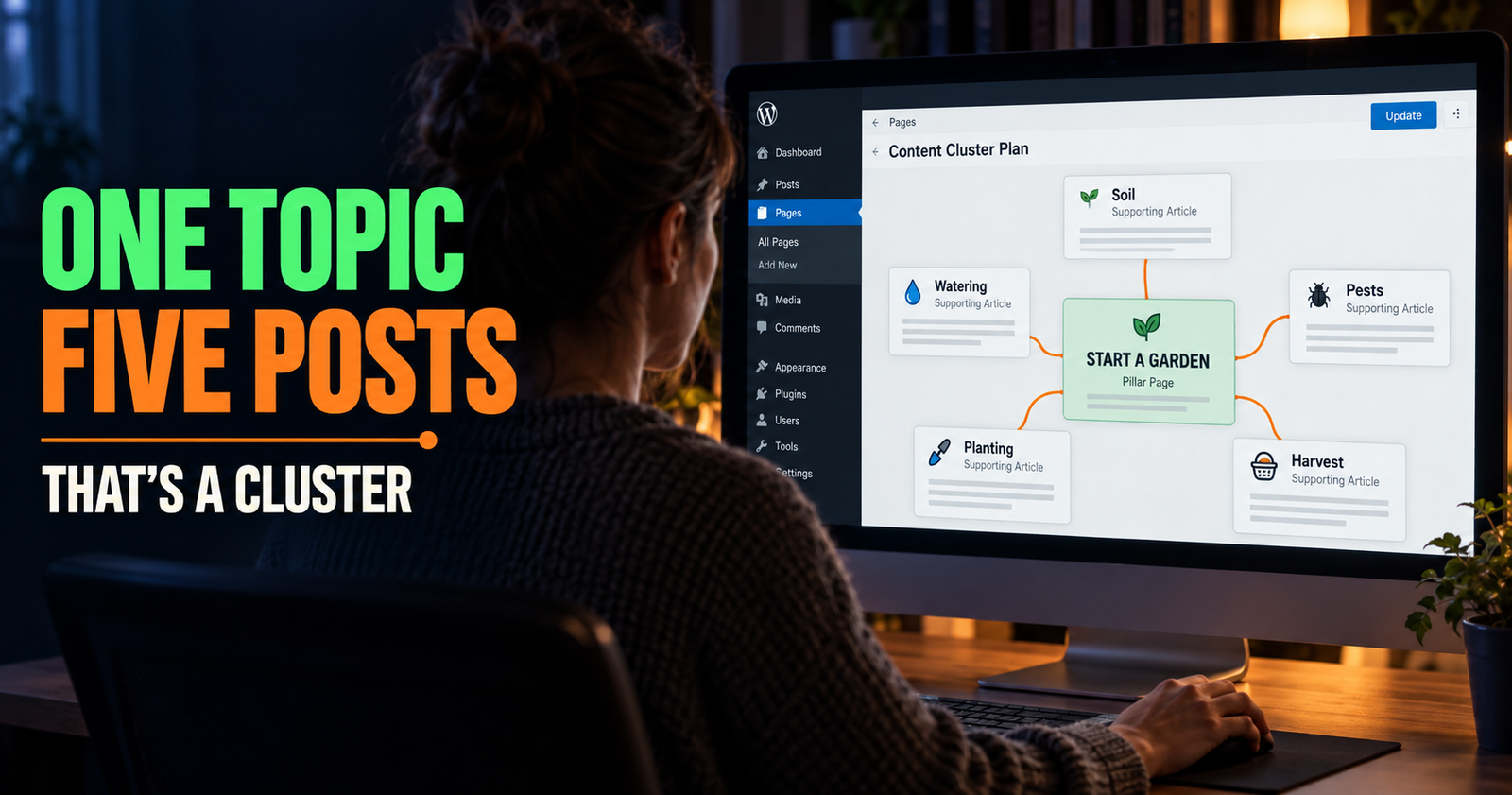
For example, a guide about building an SEO content cluster for a new website can act as the main page for a group of articles about content structure, related topics, and internal connections.
The supporting posts then handle the individual questions: how to avoid overlap, how to write anchor text, how to find orphan pages, and how to decide whether an article deserves an update.
This structure makes internal linking easier because you are not trying to invent relationships after the fact. You planned the relationships before publishing.
Give every post one sentence of purpose
Before adding a topic to your plan, write one sentence that explains exactly what the article will do.
Not the keyword. The job.
Here are the kinds of purpose statements I use:
- “This article helps a new website owner understand why Google has not indexed their site yet.”
- “This article helps someone choose between updating a weak post and creating a new one.”
- “This article helps a blogger identify posts that are competing for the same search intent.”
- “This article helps a small site owner reconnect pages that have no internal links pointing to them.”
If two planned posts have nearly identical purpose statements, they are probably too close together.
You may be able to combine them into one stronger guide, or you may need to give one of them a more specific angle.
Plan search intent before you plan headlines
A headline can change later. Search intent is the part that cannot be fuzzy.
Someone searching “how long does SEO take for a new website” wants realistic expectations. They do not need a giant list of technical SEO tasks.
Someone searching “why is my new website not showing up on Google” needs troubleshooting steps. They are probably worried that something is broken.
Someone searching “best SEO keywords” may want a list, a tool, or a research process depending on the rest of the search results.
Before you commit to a topic, ask:
- What problem is the searcher trying to solve right now?
- What kind of answer would make them feel helped?
- Is this different from another article I already have planned?
- What should the reader do next after reading it?
The answer to that last question often reveals the natural internal link for the article.
Use a “main question” and “next question” system
This is one of the easiest ways to keep a new blog from becoming repetitive.
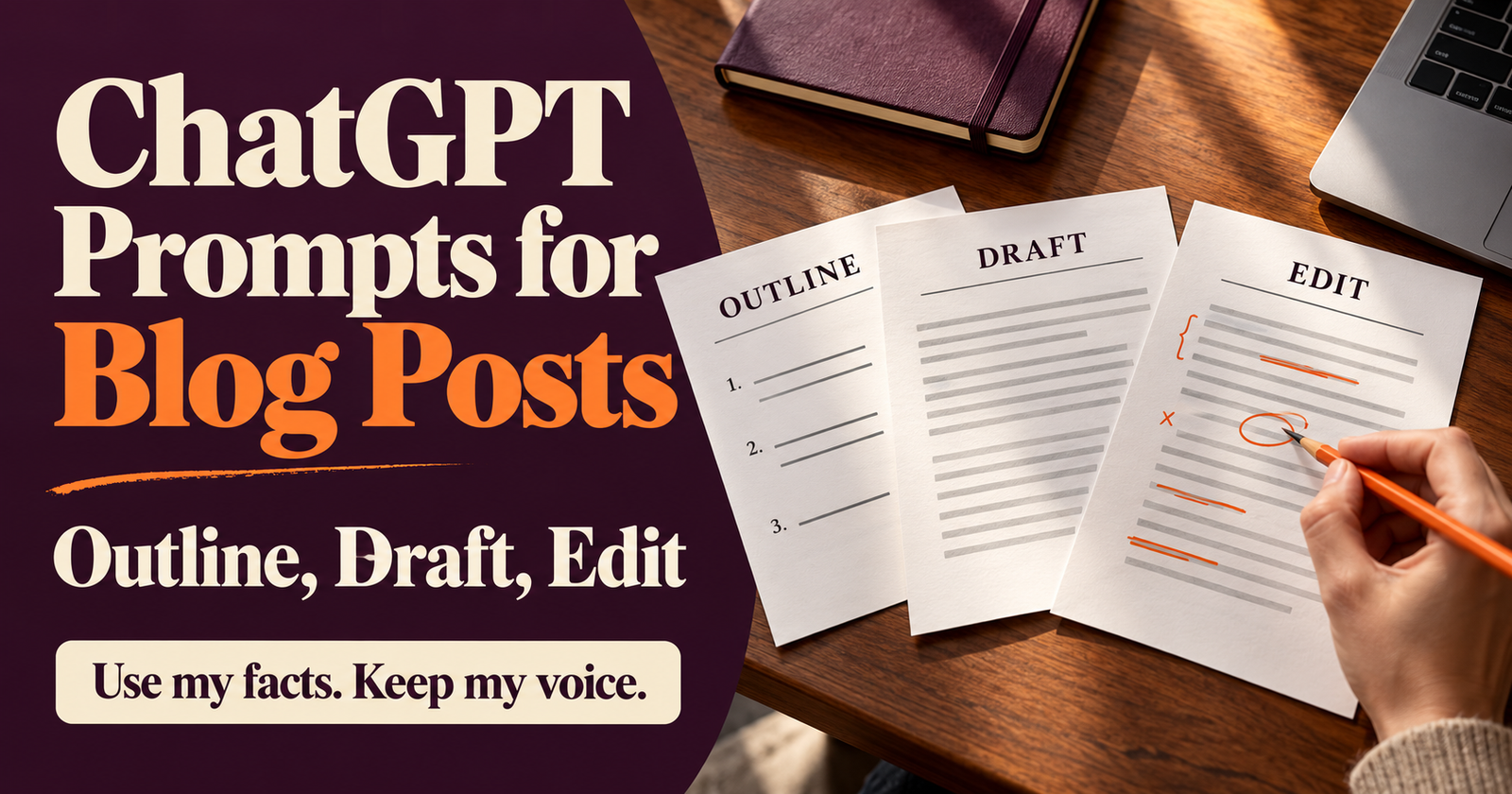
Every post should answer one main question. It should also create a reasonable next question that another post can answer. After assigning each article a clear question, prompts for outlining blog posts can help you organize its sections and identify the details you still need to add.
For example:
A beginner reads an article about finding keywords. Their next question may be whether the keyword is too competitive.
After that, they may wonder what search intent means.
Once they choose a topic, they may need help deciding how often to publish.
Later, they may need to choose between updating an older article or writing a new one.
That is a natural reader path. It also gives your internal links a real purpose instead of making them feel like decorations.
The article about whether a keyword is too competitive for a new website is not a repeat of keyword research. It is the next decision after keyword research.

Keep a “not this article” note for every topic
This sounds small, but it prevents a lot of overlap.
Under each planned headline, write a quick note about what the article will not cover in depth.
For example:
A post about “How Often Should I Post on a New Blog?” is about setting a sustainable publishing pace. It is not a full guide to choosing blog topics or refreshing old content.
A post about “What Are Orphan Pages?” is about disconnected pages in your site structure. It is not a full guide to keyword cannibalization or every possible internal-link strategy.
This gives every article a boundary. Boundaries make a content plan stronger because they force you to save related ideas for the page where they actually belong.
Do not confuse related topics with duplicate topics
Related posts are good. Duplicate posts are not.
A website can have one article about search intent, another about keyword competition, another about content clusters, and another about internal anchor text. Those subjects overlap in the same way that tools overlap in a toolbox. They work together, but each has a different job.
The problem starts when two posts are both trying to be the main answer for the exact same question.
If you are unsure, compare the opening promise of each planned article. If they promise the same outcome to the same reader, combine them or change the angle before publishing.
This is much easier than fixing it months later after both pages have accumulated links, impressions, and confusing signals.
Build a reasonable publishing order
Your first post does not have to be the broadest guide on the site. But you should publish in an order that gives each new article somewhere to connect.
A useful pattern is:
- Publish one broad foundational guide.
- Publish two or three supporting articles that answer specific questions from that guide.
- Go back and add natural internal links between them.
- Start the next group.
- Keep revisiting older pages as the cluster grows.
You do not need to wait until all thirty posts exist before linking them together. In fact, you should not. Build the structure as you go.
That is how you avoid ending up with a dozen articles that technically exist but have no path from one page to another.
Your first 30-post plan does not need to be perfect
A plan should give you direction, not make you afraid to change your mind.
You may find a better keyword. You may realize a topic needs to be narrower. You may see that two post ideas belong together. That is normal.
The point is to make deliberate changes, not publish based on whichever headline feels easiest that day.
I would rather see someone publish fifteen well-connected articles with clear purposes than thirty rushed pages that all circle the same three ideas.
A small site can build real depth fast when every post strengthens the ones around it.
A practical planning sheet to keep beside you
For every planned article, track these basic details:
- Working title.
- Main question the article answers.
- Searcher intent.
- Primary category.
- Related main guide.
- Two or three existing pages it should eventually link to.
- Two or three pages that should link back to it once published.
- A short note explaining what the article will not cover.
You do not need a complicated dashboard. A simple sheet is enough. What matters is that you can see the growing structure before it turns into a pile of unrelated drafts.
When to add the next thirty posts
Do not rush to map out one hundred posts before you have published your first thirty.
Your early articles will teach you what the site actually needs. You will see which subjects naturally branch into more questions, which articles need better support, and where readers may need a deeper guide.
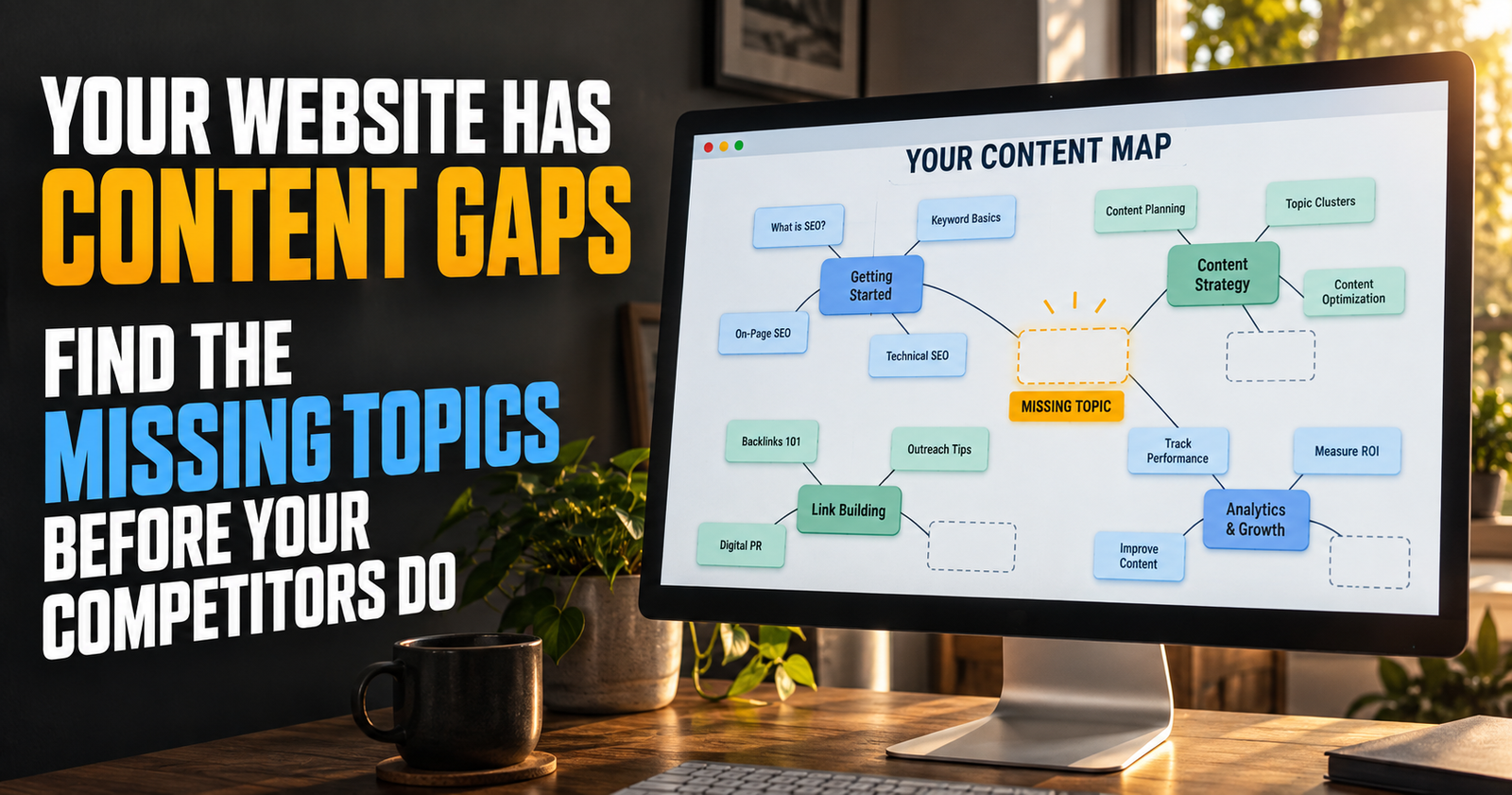
After the first thirty are planned and partly published, review the gaps. Look for questions that are missing, pages that need stronger connections, and topics that deserve their own new cluster. A useful next step is to evaluate missing reader questions before turning every missing topic into another post.
That approach is slower than chasing every keyword variation. It is also how you build a website that feels organized, trustworthy, and genuinely useful from the inside out.
Alden Whitaker writes practical, plain-English SEO guides for Make It Found that help small website owners make smarter content decisions without getting lost in agency jargon.